

China Sourcing Agent Alternative: How to Choose the Right China Sourcing Partner
News originally published by
EIN Presswire



Short answer: A sourcing agent introduces you to factories. A sourcing partner also manages what happens afterwards, such as supplier checks, samples, quality control, compliance coordination and shipping. Which one you need depends on your order size and risk. For small, simple, one-off orders, an agent can be enough. For repeat orders, custom products or several suppliers, a partner that handles the full process may save time and reduce mistakes.
This guide explains the differences, how each charges, and what to ask before you choose.
What Is the Difference Between a Sourcing Agent, a Sourcing Company and a Sourcing Partner?
These terms overlap, and companies use them differently. A practical way to compare them is by what they actually do:
Sourcing agent
Sourcing company
Full sourcing and supply chain partner
Finds factories
Yes
Yes
Yes
Verifies suppliers on site
Varies
Varies
Yes, part of the process
Manages samples and production follow-up
Sometimes
Sometimes
Yes
Quality control
Often final inspection only
Varies
Multiple stages
Compliance document coordination
Rarely
Sometimes
Yes
Shipping and customs
Usually a separate forwarder
Sometimes
Can be included
Pricing model
Often a commission
Varies
Often service fee, open-book costs
Many agents do good work. The point of the table is to help you see which tasks you expect your supplier-side partner to handle, so you can compare like with like.
When Is a Simple Sourcing Agent Enough?
An agent may be enough when:
The order is small or one-off
The product is standard, not custom
You already know the factory or have a trusted contact
You will handle inspection and shipping yourself
A partner that manages the whole process is more useful when you have repeat orders, custom products, several suppliers, or strict quality and compliance needs. Sinolinkers’ custom sourcing service is built for these cases. It may not be the best fit for very small or one-off orders.
How Do Sourcing Partners Charge?
Model
How it works
What to ask
Commission
A percentage of the order value
Is the commission fixed and disclosed? Does the agent also earn from the factory?
Fixed service fee
A set fee per project or per month
What does it include?
Open-book pricing
Factory costs and service fee are shown separately
Can you see the factory quote and what is added?
Whatever the model, the key question is whether the partner is paid only by you, or also by the factory. If it is paid by both, you should know. A clear, written fee structure matters more than the model itself.
What Should Buyers Check Before Choosing a Sourcing Partner?
Use this checklist:
Is the fee structure clear and written down? Is any factory commission disclosed?
Do they audit suppliers on site, or only introduce them?
Who does the inspections: full-time staff or freelancers?
Is quality control done only at the end, or also during production?
Who owns the tooling, molds and supplier relationships?
Do they help with compliance documents for your market?
Can they handle shipping and customs, or will you need another company?
Do they have a team in the factory regions that matter for your product?
Will you be told which factory makes your goods?
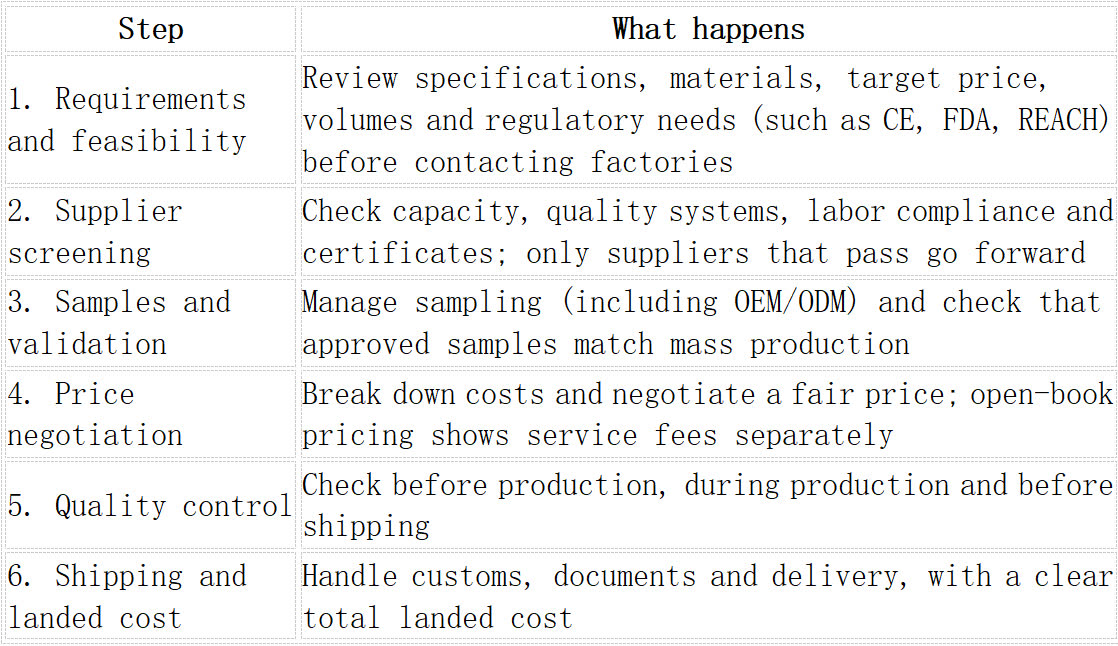
How Does a Sourcing Project Work, Step by Step?
Step
What happens
1. Requirements and feasibility
Review specifications, materials, target price, volumes and regulatory needs (such as CE, FDA, REACH) before contacting factories
2. Supplier screening
Check capacity, quality systems, labor compliance and certificates; only suppliers that pass go forward
3. Samples and validation
Manage sampling (including OEM/ODM) and check that approved samples match mass production
4. Price negotiation
Break down costs and negotiate a fair price; open-book pricing shows service fees separately
5. Quality control
Check before production, during production and before shipping
6. Shipping and landed cost
Handle customs, documents and delivery, with a clear total landed cost
Who Should Own the Tooling and Supplier Relationships?
In some arrangements, tooling or supplier contracts stay in the agent’s name, which can make it hard to change factories later. Whoever you work with, ask for ownership of tooling, drawings and supplier details to be written into the agreement, and have the contract reviewed by a lawyer where the stakes are high.
Why Do Hubs in More Than One Region Matter?
Different products come from different industrial areas. A partner with teams in more than one region can follow products that need engineering and electronics expertise, and also handle large volumes of mixed goods. Sinolinkers operates from Shenzhen, where it oversees engineering, electronics sourcing and compliance, and from Yiwu, where a team of more than 100 handles SKU consolidation, labeling and shipment preparation. This helps when demand spikes, such as the surge in event merchandise around the 2026 FIFA World Cup procurement demand.
What Does Sinolinkers Do as a Sourcing Partner?
Sinolinkers helps overseas buyers manage the full process in China, from finding suppliers to production, quality control, compliance coordination and international shipping. In practice, that means:
Finding and auditing suppliers, including certificate checks
Managing OEM/ODM development and sampling
Open-book pricing with a clearly defined service fee
Multi-stage QC by full-time in-house staff
Product compliance coordination
Shipping, customs and delivery through Toncent Logistics
Tooling and supplier relationships are structured to remain with the client.
FAQ
Is a sourcing agent the same as a sourcing company?Not always. The terms are used loosely. Compare what each company actually does and how it is paid, not the name.
How can I tell whether an agent takes commissions from factories?Ask directly, and ask for the fee structure in writing. Open-book pricing, where factory costs and service fees are shown separately, makes this clearer.
Do I need a sourcing partner for a small order?Usually not. For small or one-off orders, a simpler arrangement may cost less. A partner makes more sense for repeat orders, custom products and several suppliers.
Can I change factories later?Often yes, if you own the tooling and have the supplier details and technical files. Agree this before production starts.
What should a sourcing partner give me beyond a factory list?Audit reports, sample checks, inspection reports, compliance documents and a clear landed-cost breakdown, in addition to the supplier introductions.
Looking for a partner to manage sourcing, quality and shipping in China? Visit sinolinkers.com to talk to the team.
sinolinkers
sinolinkers
Legal Disclaimer:
EIN Presswire provides this news content "as is" without warranty of any kind. We do not accept any responsibility or liability for the accuracy, content, images, videos, licenses, completeness, legality, or reliability of the information contained in this article. If you have any complaints or copyright issues related to this article, kindly contact the author above.
