
How to Choose a China OEM/ODM Partner: What Buyers Should Check Before Development Starts
News originally published by
EIN Presswire


Short answer: A good China OEM/ODM development partner should be able to review your design for manufacturability, build samples you can approve, document who owns the tooling and files, and run a pilot batch before mass production. Unit price matters, but it is only one part of the decision. Most costly problems, such as mold changes, delays and quality drift, come from skipped steps early in the project.
This guide covers what to check and in what order.
What Is the Difference Between OEM and ODM?
In practice, many projects sit in between: an ODM base design with custom changes. Because of this, ownership of the modified design, the tooling and the files should be written into the contract before development begins.
What Should Buyers Check Before Choosing an OEM/ODM Partner?
Use this checklist when comparing suppliers:
Is it a real factory or a trading company? Ask for a factory audit or video of the production lines.
Do they review your design (DFM) before making molds?
Will the contract state who owns the molds, CAD files, firmware and fixtures?
Do they make T1/T2 samples and a signed Golden Sample?
Do they run a pilot batch before mass production?
Can the molds and fixtures be moved to another factory if needed?
Can they provide test reports or help with certifications for your target market?
Is the quote itemized (tooling, unit price, sample cost) rather than a single number?
Quotes that look cheap often leave out tooling changes, sample fees or compliance testing. Ask what is included in each line.
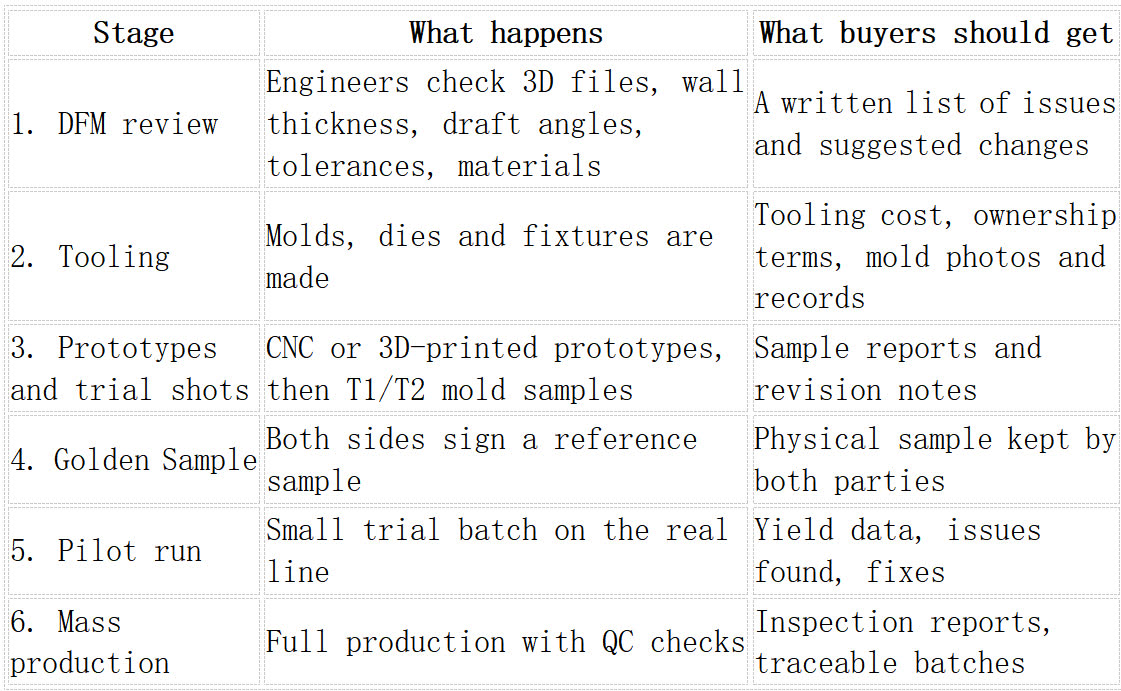
How Does the OEM/ODM Development Process Work?
Why does DFM matter? Changing a design on paper costs little. Changing a steel mold can cost much more and delay the launch by weeks. A DFM review catches problems such as uneven wall thickness or tolerances that are hard to hold before the mold is cut.
Why a pilot run? Samples made by hand do not always reflect what the production line can do. A pilot batch shows line-balancing problems, yield drops and assembly issues while the order is still small.
Who Should Own the Molds and Design Files?
For custom products, buyers usually want to own the molds, fixtures and design files they paid for. A common mistake is paying for tooling without any written terms, which can make it hard to move production later.
Points to put in writing:
Who owns the molds and fixtures, and where they are stored
Who owns CAD files, Gerber files and firmware
What happens to modified or co-developed designs
Whether the buyer can move the tooling to another factory
Ownership rules and enforceability depend on the contract and on local law, so buyers should have the agreement reviewed by a qualified lawyer, ideally one familiar with China.
How Can Buyers Reduce IP Risk When Working With Chinese Factories?
There is no single safeguard. Buyers usually combine several:
Clear ownership terms in the contract (see above).
Confidentiality and non-use agreements. Many buyers use an NNN agreement (non-disclosure, non-use, non-circumvention) drafted under Chinese law, rather than a generic NDA written for another country. A lawyer should confirm what is enforceable in your case.
Limiting what is shared. Share only the files needed at each stage.
Keeping documents and tooling portable. Keep complete technical files and records so production can move if needed.
How Does Sinolinkers Handle OEM/ODM Projects?
Sinolinkers helps overseas buyers manage the whole process in China, from finding suppliers to production, quality control, compliance coordination and international shipping. For OEM/ODM projects, this includes:
Reviewing CAD files, drawings or reference samples for manufacturability (DFM) before development starts
Matching the project with factories based on materials, tolerances and assembly needs, not only on lowest price, and auditing those factories
Overseeing mold design, fabrication and testing
Managing sample rounds until a Golden Sample represents mass-production output
Supervising pilot runs, then multi-stage QC during mass production
Coordinating product compliance documents for the target market
Arranging shipping through Toncent Logistics
On tooling, Sinolinkers’ standard approach is that molds are identified in the contract and physically marked as the client’s property, so production can be moved to another factory if the first one underperforms.
After launch, see our guide on optimizing OEM inventory and supply chain resilience for managing stock and lead times.
FAQ
How long does OEM/ODM development usually take?It depends on the product. Simple items may take weeks, while products with new molds and electronics can take several months. Ask each supplier for a timeline by stage.
Can I switch factories after the mold is made?Often yes, if you own the mold and have the full documentation. Check this in the contract before paying for tooling.
Can I start without technical drawings?Often yes. A reference product or a clear functional description can be turned into specifications and a 3D model, but expect extra time for the design stage.
Is ODM safer than OEM?Not necessarily. ODM can be faster and cheaper, but the design may be shared with other buyers unless exclusivity is agreed in writing.
Do I need a pilot run for every order?Not always, but it is strongly recommended for new products, new molds or new factories.
Ready to start an OEM/ODM project in China? Visit sinolinkers.com to talk to the team.
sinolinkers
sinolinkers
Legal Disclaimer:
EIN Presswire provides this news content "as is" without warranty of any kind. We do not accept any responsibility or liability for the accuracy, content, images, videos, licenses, completeness, legality, or reliability of the information contained in this article. If you have any complaints or copyright issues related to this article, kindly contact the author above.
