

Startup Launches First AI Knowledge Clearinghouse, Paying Experts Royalties for AI Use of Their Work
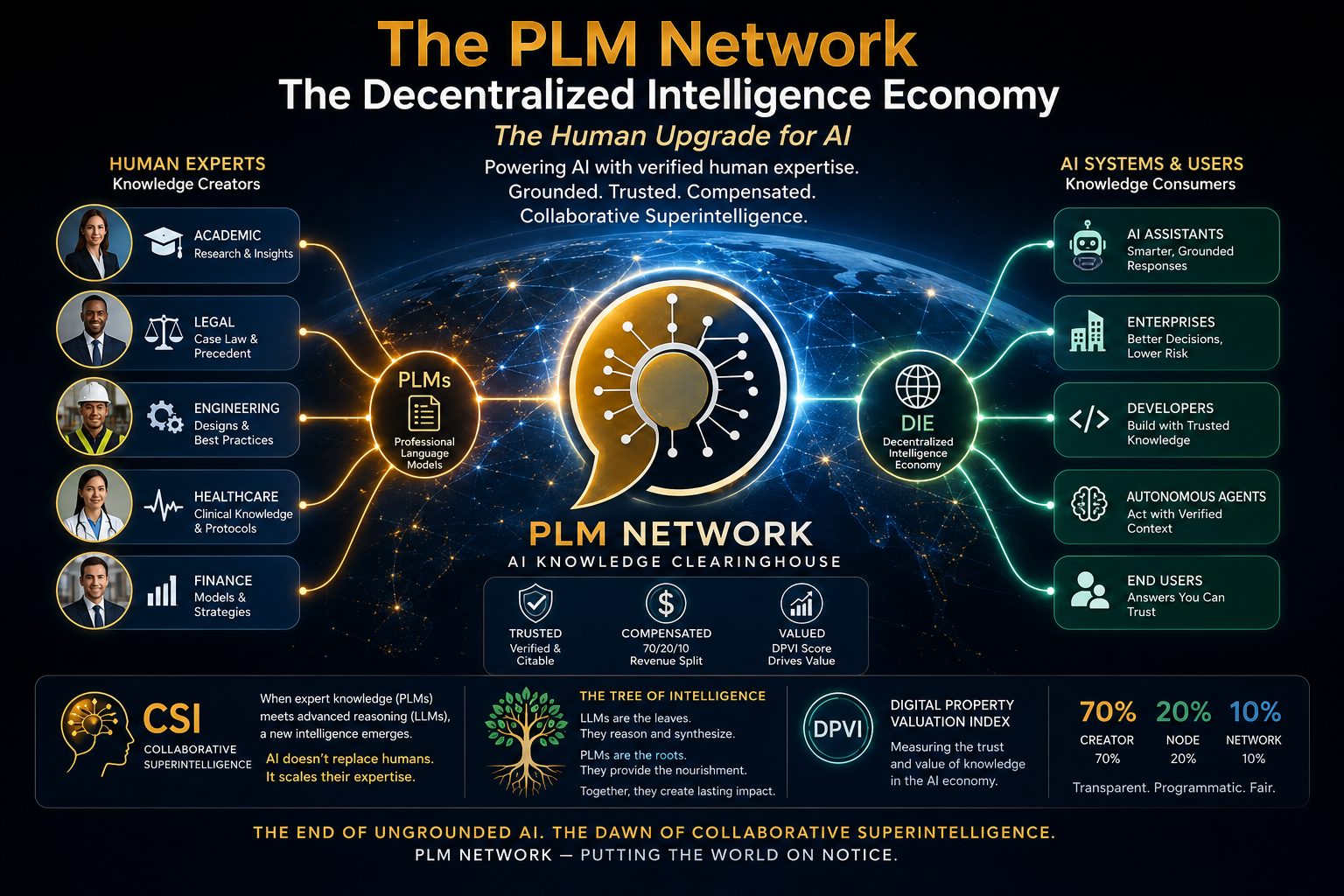
Decentralized Intelligence Economy
Professional Language Models, Inc has launched the PLM Network a framework where human expertise is an owned, verified, queried and monetizable digital asset.
Intelligence is like a tree. The frontier models are the leaves. Human expertise, captured as a PLM is the root system. The PLM Network is the trunk and the limbs. It's the Human Upgrade for AI”
DURHAM, NC, UNITED STATES, July 10, 2026 /EINPresswire.com/ -- As federal courts prepare to issue a wave of rulings on artificial intelligence and copyright following a $1.5 billion settlement against Anthropic in 2025, a Durham, North Carolina company has introduced a new economic framework designed to address the central legal and ethical question at the heart of those disputes: who gets paid when AI uses human expertise?— Phil Bridgeman
Professional Language Models, Inc. announced this week the launch of the PLM Network and the Decentralized Intelligence Economy, a system that registers expert knowledge as owned digital property and routes royalty payments to creators whenever that knowledge is accessed by an AI system. The company describes the model as the first performance rights organization for artificial intelligence, drawing a direct parallel to BMI and ASCAP — the organizations that collect and distribute royalties to musicians when their work is broadcast or performed.
"The PLM Network is to AI knowledge what BMI is to music," the company states in its technical white paper. Under the model, when a frontier AI system queries knowledge registered on the PLM Network, a royalty event is recorded and a micropayment is issued to the expert who created it.
A New Class of Digital Property
At the core of the system is a new type of knowledge asset the company calls a Professional Language Model (PLM) — a structured, domain-specific knowledge container built on Retrieval-Augmented Generation (RAG) technology. Unlike conventional AI training, in which expert knowledge is absorbed into a model's weights and loses all attribution, a PLM remains owned by its creator, carries verifiable citations, and generates recurring revenue through per-query micropayments, subscriptions, and licensing agreements.
The company's revenue model distributes 70 percent of each transaction to the knowledge creator, 20 percent to the infrastructure node provider, and 10 percent to the platform — settled in USDC micropayments and traditional payment rails.
Complementing, Not Competing With, Frontier AI
PLM, Inc. positions the network as infrastructure that works alongside — not against — the large language models developed by OpenAI, Anthropic, and Google. Co-Founder and Chief Innovation Officer Philip Bridgeman describes the relationship through what he calls the Tree of Intelligence:
"Intelligence is like a tree. The frontier models — the massive reasoning engines built by OpenAI, Anthropic, and Google — are the leaves. They are highly visible, they catch the sunlight, and they perform the complex synthesis that we see. But leaves cannot survive without a root system. Human expertise, captured as Professional Language Models, is the root system. It is deep, grounded, and draws the essential nutrients of truth and fact from the soil of lived experience. The PLM Network is the trunk and the limbs — the vital infrastructure that connects the roots to the leaves, routing the nutrients of human knowledge up to the reasoning engines so the entire tree can thrive."
The company refers to the resulting architecture as Collaborative Superintelligence — a system in which verified human expertise and frontier AI reasoning operate together rather than in competition.
Infrastructure Already Operational
PLM, Inc. reports that the core network is currently live, including a public marketplace at PLMMarket.com, production APIs, a Retrieval-Augmented Generation orchestration layer, and a Windows-native AI agent called Sqwibbl that can operate desktop software while drawing on verified expert knowledge in real time. The company has filed three provisional patents with the U.S. Patent and Trademark Office, with a fourth covering the clearinghouse model in preparation.
The announcement comes as the AI industry faces intensifying scrutiny over intellectual property, with ongoing litigation involving major AI developers and growing legislative activity in the United States and European Union aimed at establishing clearer standards for how AI systems may compensate creators.
About Professional Language Models, Inc.
Professional Language Models, Inc. is headquartered in Durham, North Carolina. The company develops the PLM Network, PLMMarket.com, the Digital Property Valuation Index (DPVI), and Sqwibbl.
Media Contact
Bradley P. Jones, Co-Founder & CEO — bpjones@plmmarket.com
Philip Bridgeman, Co-Founder & Chief Innovation Officer — pbridgeman@plmmarket.com
plmmarket.com | sqwibbl.ai
Bradley Jones
Professional Language Models Inc
+1 919-349-5633
email us here
Visit us on social media:
LinkedIn
Instagram
YouTube
Other
Legal Disclaimer:
EIN Presswire provides this news content "as is" without warranty of any kind. We do not accept any responsibility or liability for the accuracy, content, images, videos, licenses, completeness, legality, or reliability of the information contained in this article. If you have any complaints or copyright issues related to this article, kindly contact the author above.
