
Capacitor Market Set to Advance Energy Storage Solutions at a 5.7% CAGR
capacitor market
Capacitor Market Size, Share and Research Report By Capacitor Type (Ceramics, Aluminum, Tantalum, Papers and Plastics, Supercapacitors), By End Use Industry
The Capacitor Market is expanding steadily, driven by rising demand for consumer electronics, electric vehicles, renewable energy systems, and industrial automation.”
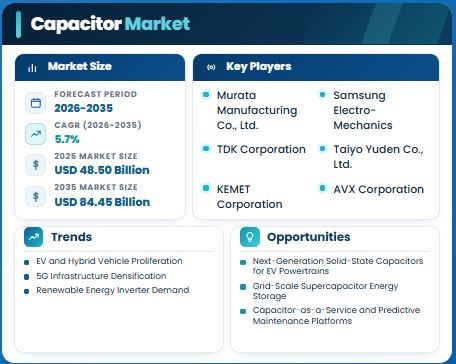
TAIPEI, TAIPEI, TAIWAN, July 6, 2026 /EINPresswire.com/ -- The Global capacitor market was valued at USD 48.50 billion in 2025 and is projected to grow from USD 51.26 billion in 2026 to USD 84.45 billion by 2035, registering a CAGR of 5.7% during the forecast period. — Market Research Future (MRFR)
Two major catalysts are accelerating this trajectory: the explosive proliferation of battery electric vehicles where a single EV traction inverter system embeds hundreds of high-performance film and ceramic capacitors for power conversion, energy storage, and EMI suppression, requiring component volumes and reliability grades far exceeding those of internal combustion engine vehicles and the global 5G infrastructure buildout, where each base station requires more than 10,000 MLCCs for radio-frequency signal management, power supply stabilization, and thermal regulation across dense antenna arrays.
With AI server deployments additionally requiring up to eight times more MLCCs per unit compared to conventional server architectures, and the U.S. Department of Energy reporting that inverter-based renewable energy systems now constitute 26% of grid-connected U.S. power generation with each solar inverter embedding more than 2,000 MLCCs for voltage regulation, the structural depth of capacitor demand has never been broader or more resilient to end-market concentration risk.
Legacy general-purpose capacitor production is rapidly giving way to high-reliability, miniaturized, and application-specific platforms engineered for the extreme thermal, vibration, and electrical stress profiles of automotive powertrains, 5G mmWave infrastructure, and high-density AI compute racks. Murata Manufacturing announced a 15%–35% price increase for high-end automotive and AI server MLCCs effective April 1, 2026, driven by production utilization exceeding 80% on high-end capacity lines and simultaneously announced construction of a new MLCC facility in Izumo, Japan, responding to surging demand from automotive and industrial automation sectors.
Samsung Electro-Mechanics confirmed automotive MLCCs had reached 15% of its total MLCC revenue by Q1 2025 with potential to surpass 25% by year-end, while Taiyo Yuden commercialized embedded MLCCs for AI servers and introduced a 1000V MLCC series with extended lifespan for EV traction inverters. The era of capacitors as undifferentiated commodity components is decisively over; precision-engineered passive components are now strategic supply chain assets.
Get Full PDF Sample Copy of Report: (Including Full TOC, List of Tables & Figures, Chart) @
https://www.marketresearchfuture.com/sample_request/11905
➤ How Significant Is the Capacitor Market’s Growth?
The capacitor market has demonstrated consistent and robust expansion, nearly doubling from USD 48.50 billion in 2025 to a projected USD 84.45 billion by 2035, underpinned by structural demand forces that are simultaneously broadening the market’s end-use base and raising average unit values across every major capacitor type. Ceramic capacitors particularly multilayer ceramic capacitors (MLCCs) dominate the market as the largest segment by revenue, with the top four vendors (Murata, TDK, Samsung Electro-Mechanics, and Taiyo Yuden) collectively accounting for more than 60% of global MLCC market value.
The consumer electronics segment is projected to grow from USD 12.0 billion in 2025 to USD 25.0 billion by 2035, while the aluminum capacitor segment is expected to expand from USD 10.0 billion to USD 20.0 billion over the same period, driven by widespread deployment in power electronics, automotive systems, and industrial frequency inverters.
Supercapacitors represent the fastest-growing capacitor segment, projected to expand from USD 13.64 billion in 2025 to USD 25.66 billion by 2035 as energy storage and regenerative braking applications in EVs, grid-scale power buffering, and industrial uninterruptible power systems drive adoption beyond their traditional role as backup power components.
High-voltage capacitors are anticipated to grow from USD 17.06 billion in 2025 to USD 32.83 billion by 2035, reflecting intensifying investment in high-voltage direct-current (HVDC) transmission systems for long-distance and cross-border power transfer, large-scale solar and wind farm grid interconnection, and the power conversion stages of EV fast-charging infrastructure. The automotive electronics segment is growing at approximately 7% annually, with MLCC content per EV exceeding content per ICE vehicle by multiples across powertrain, ADAS, infotainment, and body electronics applications.
➤ What Does the Future Hold for the Capacitor Market?
Advanced materials innovation and extreme miniaturization stand at the forefront of the capacitor market’s next growth phase. Murata’s commercialization of the world’s smallest 006003-size MLCC and a 47µF 0402 MLCC with 800 dielectric layers enabled by sub-0.5µm copper electrode technology that could double capacitance density while cutting production costs significantly illustrates the pace at which passive component engineering is advancing.
Kyocera’s 2023 commercialization of a 10µF MLCC in EIA 0201 size, claiming the largest capacitance among all 0201 MLCCs available, and Taiyo Yuden’s 22µF 0402 embedded MLCC optimized for close IC placement in AI server motherboards, reflect an industry where each successive generation delivers meaningfully more capacitance in meaningfully less board space enabling AI accelerator and 5G radio designs that would be physically impossible with prior-generation components.
The geopolitical dimension of the capacitor supply chain is reshaping investment patterns across the global market. Chinese MLCC manufacturers including Guangdong Fenghua Advanced Technology, Chaozhou Three-Circle Group, and Eyang Technology have expanded their collective global market share to approximately 10% of total MLCC revenue by the second half of 2024 a four-percentage-point increase from 2019 creating intensifying competitive pressure on established Japanese, Korean, and Taiwanese suppliers, particularly in IT-grade commodity segments.
In response, Murata, Samsung Electro-Mechanics, and Taiyo Yuden are collectively accelerating strategic pivots toward higher-value automotive-grade, AI server, and high-frequency 5G product lines where Chinese competitors have not yet achieved equivalent quality certifications or production scale. Capacity diversification into Southeast Asia is also accelerating, with Murata expanding manufacturing across Japan and Southeast Asia and DJI establishing supply chain infrastructure in Vietnam.
Sustainability is increasingly shaping both product design and manufacturing strategy across the capacitor market. Regulatory frameworks including the EU RoHS Directive, REACH regulation, and emerging end-of-life electronics legislation are compelling manufacturers to develop lead-free dielectric formulations, introduce recyclable packaging, and reduce per-unit energy consumption in high-volume MLCC production.
Murata’s commitment to sustainability through lead-free product lines and Taiyo Yuden’s structural transformation toward higher-value, lower-volume product portfolios both reflect a market-wide recognition that environmental compliance is transitioning from a cost of market access to a competitive differentiation criterion in regulated procurement environments.
➤ Who Are the Key Players in the Capacitor Market?
The capacitor market is characterized by a tiered competitive structure: a small number of Japanese and Korean multinationals command the high-reliability, high-value automotive and advanced electronics segments, while a growing cohort of Taiwanese and Chinese manufacturers compete aggressively in commodity IT and consumer electronics tiers. Key participants shaping the competitive dynamics include:
Murata Manufacturing Co., Ltd. - the undisputed global MLCC market leader commanding approximately 40–50% of the automotive-grade MLCC segment, pursuing a “strengthening high-end” strategy that prioritizes automotive, ultra-miniature, high-capacitance, and high-reliability applications; announced a 15–35% price increase for high-end MLCCs effective April 2026 and began construction of a new Izumo MLCC facility in February 2024 to meet surging AI server and automotive demand.
Samsung Electro-Mechanics Co., Ltd. - the second-largest global MLCC producer and recipient of Qualcomm’s 2024 Supplier of the Year Components Award; holds approximately 40% of the global AI server MLCC segment by revenue, with automotive MLCCs comprising 15% of total MLCC revenue in Q1 2025 and targeted to exceed 25% by end-2025 as the dedicated Busan automotive production line scales.
Taiyo Yuden Co., Ltd. - a specialist in high-reliability capacitors for automotive, communications, and medical electronics; commercialized a 1000V MLCC series with extended lifespan for EV traction inverters and a 22µF 0402 embedded MLCC for AI server close-IC placement, pursuing a structural transformation toward higher-value markets with overall production utilization at approximately 85% in 2025; issued MLCC price increases effective May 2026.
★ AVX Corporation (KYOCERA AVX) - a leading U.S.-headquartered passive component manufacturer, a subsidiary of Kyocera Corporation, delivering MLCCs, tantalum capacitors, film capacitors, and supercapacitors across automotive, aerospace, defense, and industrial markets; Kyocera AVX commercialized the largest capacitance 0201-size MLCC at 10µF in April 2023, advancing the miniaturization frontier.
★ KEMET Corporation (Yageo Group) - now part of Yageo Corporation following acquisition, providing a broad portfolio of aluminum electrolytic, tantalum, film, and ceramic capacitors for industrial, automotive, and telecommunications markets; Yageo Group collectively holds a significant share of the global passive component market and has been expanding automotive-grade MLCC product lines.
★ Nippon Chemi-Con Corporation - a global leader in aluminum electrolytic capacitors, serving power electronics, automotive, industrial automation, and energy storage applications with high-capacitance, long-life electrolytic products engineered for demanding thermal environments in EV charging systems and industrial motor drives.
★ Vishay Intertechnology, Inc. - a diversified passive component manufacturer delivering tantalum, ceramic, film, and electrolytic capacitors across industrial, automotive, military, and medical markets; in May 2022 launched wet tantalum capacitors using SuperTan technology with industry-leading capacitance-per-voltage ratings in B and C case codes for avionics and military electronics applications.
★ Würth Elektronik GmbH & Co. KG - a leading European passive component manufacturer and distribution specialist delivering ceramic, aluminum electrolytic, and film capacitors with strong engineering support services across industrial automation, power supply, and automotive electronics markets in Europe and globally.
Competition in the market is intensifying as Chinese manufacturers including Guangdong Fenghua Advanced Technology and Chaozhou Three-Circle Group rapidly expand IT-grade MLCC capacity and market share, compelling Japanese and Korean incumbents to accelerate migration toward AEC-Q200 automotive-grade, IATF 16949-certified production, and AI server ultra-high-capacitance product lines where qualification barriers, ceramic powder technology depth, and long-term reliability track records remain decisive competitive moats.
➤ What Are the Emerging Trends in the Capacitor Market?
Several transformational trends are redefining how the capacitor market evolves through 2035:
Extreme Miniaturization & Ultra-High-Capacitance MLCC Development: The push toward smaller form factors with higher capacitance is reaching physical limits that require fundamental advances in ceramic dielectric chemistry, electrode layer thinness, and sintering precision. Murata’s 800-layer 47µF 0402 MLCC and sub-0.5µm copper electrode technology, capable of doubling capacitance density, define the current frontier, while sub-006003 and embedded MLCC architectures for AI server and automotive close-IC placement represent the next generation of miniaturization-driven value creation.
EV & ADAS Automotive-Grade Demand Surge: Electric vehicle powertrains, ADAS sensor fusion platforms, high-voltage battery management systems, and onboard EV fast-charging circuits collectively require capacitor content levels 3–5 times higher per vehicle than conventional ICE architectures. Taiyo Yuden’s 1000V EV traction inverter MLCC series and Samsung Electro-Mechanics’ dedicated Busan automotive MLCC line illustrate how leading manufacturers are structurally repositioning production capacity toward automotive-grade AEC-Q200-qualified components that command premium pricing and multi-year supply agreements.
AI Server & Data Center Capacitor Demand Acceleration: AI accelerator servers require up to eight times more MLCCs per unit than conventional servers, driven by dense power delivery networks, high-frequency voltage regulation for GPU and NPU compute arrays, and the EMI suppression requirements of high-bandwidth memory interfaces. Samsung’s approximately 40% AI server MLCC market share and Taiyo Yuden’s 22µF 0402 embedded AI server MLCC reflect the rapid emergence of data center infrastructure as a structurally important demand node alongside automotive and consumer electronics.
Supercapacitor Adoption in Energy Storage & Regenerative Systems: Supercapacitors are transitioning from niche backup-power applications toward mainstream energy storage roles in EV regenerative braking systems, grid-scale power quality buffers, industrial uninterruptible power supplies, and transit vehicle kinetic energy recovery platforms, driven by their superior power density, cycle life exceeding one million charge-discharge cycles, and near-instantaneous charge acceptance that lithium-ion batteries cannot match for high-rate applications.
Sustainability, Lead-Free Formulations & Supply Chain Regionalization: EU RoHS and REACH compliance requirements are driving industry-wide migration toward lead-free dielectric formulations and halogen-free packaging materials, while geopolitical semiconductor supply chain vulnerabilities are compelling OEMs to dual-source from both Asian tier-1 suppliers and qualifying alternative manufacturers.
The emergence of Chinese MLCC producers at 10% global market share is simultaneously expanding supply diversity and intensifying margin pressure in commodity segments, accelerating the strategic pivot of Japanese and Korean leaders toward differentiated high-reliability product portfolios.
Get access to the full description of the report @
https://www.marketresearchfuture.com/reports/capacitor-market-11905
➤ How Is the Capacitor Market Segmented?
The capacitor market report provides a comprehensive segmentation framework:
By Capacitor Type: Ceramic (MLCC, Single-Layer), Aluminum Electrolytic, Tantalum, Film (Polyester, Polypropylene), Supercapacitors (Electrochemical Double-Layer, Pseudocapacitors, Hybrid), Paper & Plastic
By End-Use Industry: Consumer Electronics (Smartphones, Tablets, Wearables, Laptops), Automotive (EV Powertrain, ADAS, Infotainment), Telecommunications & 5G Infrastructure, Industrial Automation & Robotics, Renewable Energy Systems, Computers & Data Centers, Medical Electronics, Aerospace & Defense
By Voltage: Low Voltage (Below 100V), Medium Voltage (100V–1kV), High Voltage (Above 1kV)
By Dielectric Material: Class I Ceramic (C0G/NP0), Class II Ceramic (X7R, X5R, Y5V), Aluminum Oxide, Tantalum Pentoxide, Polymer Film, Activated Carbon (Supercapacitors)
By Application: Power Supply & Voltage Regulation, Signal Filtering & Noise Suppression, Energy Storage & Backup Power, Power Factor Correction, RF & High-Frequency Applications, Sensor Interface & ADC Decoupling
➤ What Are the Regional Insights from the Capacitor Market?
North America remains the largest regional market for capacitors in 2025, driven by high consumer electronics demand, a robust defense and aerospace electronics procurement base, and the world’s most advanced AI data center cluster where the explosive growth of GPU-accelerated compute racks is generating AI server MLCC demand that is tightening supply allocations across Tier-1 producers. The North American MLCC market is characterized by a strong emphasis on quality, reliability, and technological advancement, with the increasing adoption of 5G technology and the expansion of EV production serving as the two primary near-term demand acceleration vectors.
Asia-Pacific is both the largest production base and the fastest-growing consumption region for capacitors, fueled by rapid industrialization, urbanization, expanding EV manufacturing capacity, and the world’s highest density of consumer electronics assembly operations. Japan, South Korea, Taiwan, and China collectively host the majority of global MLCC production capacity, with Murata, Samsung Electro-Mechanics, Taiyo Yuden, TDK, and Yageo Corporation representing the dominant supply-side participants.
Europe holds the third-largest regional market share, anchored by Germany’s world-leading automotive electronics industry, Scandinavia’s renewable energy infrastructure buildout, and Würth Elektronik’s strong pan-European distribution network serving industrial and power electronics OEMs. EU RoHS Directive compliance requirements and REACH chemical regulations are creating non-discretionary product reformulation investment across European capacitor suppliers and their global supply chains.
South America and the Middle East and Africa represent emerging markets for capacitors, primarily driven by telecommunications infrastructure expansion including 5G rollout across Brazil, Mexico, Saudi Arabia, and the UAE and growing consumer electronics assembly and distribution ecosystems. Brazil’s expanding automotive manufacturing sector and the Gulf Cooperation Council’s Vision 2030 smart city and renewable energy programs represent the primary near-term demand catalysts in these geographies.
➤➤➤ Industry Analysis Reports by Market Research Future:
Digital Security Control Market
https://www.marketresearchfuture.com/reports/digital-security-control-market-30069
Automated Algo Trading Market
https://www.marketresearchfuture.com/reports/automated-algo-trading-market-31242
Certificate Of Deposit Market
https://www.marketresearchfuture.com/reports/certificate-of-deposit-market-31359
3D Surveillance Software Market
https://www.marketresearchfuture.com/reports/3d-surveillance-software-market-31471
Next Generation 3D Display Market
https://www.marketresearchfuture.com/reports/next-generation-3d-display-market-31554
Generative Ai In Insurance Market
https://www.marketresearchfuture.com/reports/generative-ai-in-insurance-market-31676
3D 25D Tsv Interconnect Advanced Packaging Market
https://www.marketresearchfuture.com/reports/3d-25d-tsv-interconnect-advanced-packaging-market-31944
Smartphone Lidar Market
https://www.marketresearchfuture.com/reports/smartphone-lidar-market-32034
Retail Banking Market
https://www.marketresearchfuture.com/reports/retail-banking-market-32246
Blockchain Device Market
https://www.marketresearchfuture.com/reports/blockchain-device-market-32384
Sagar Kadam
Market Research Future
+1 628-258-0071
email us here
Legal Disclaimer:
EIN Presswire provides this news content "as is" without warranty of any kind. We do not accept any responsibility or liability for the accuracy, content, images, videos, licenses, completeness, legality, or reliability of the information contained in this article. If you have any complaints or copyright issues related to this article, kindly contact the author above.
